
[Home] [Up] [Heart Rates] [Temperature] [Volume]


calculate now
                THE ONE STOP CALCULATION SHOP


SEARCH THE CALCULATE NOW WEBSITE: Google


Maximum Heart Rate     Calculate MHR    Calculate HRR and Zones

It has long been accepted as an approximation, that your Maximum Heart Rate (MHR) starts out at 220 beats per minute and falls by one beat each year. Therefore, you can calculate your Maximum Heart Rate by deducting your age from 220. So a good estimate of Maximum Heart Rate for a 40 year old is 180 (220-40 (age)) and for a 20 year old is 200 (200-20).

However, the relationship is not perfectly linear and as we age, especially if we maintain a high level of fitness, our Maximum Heart Rate falls by less than one beat each year. A closer approximation is to accept the one year one beat rule until you reach 30. After 30 it is only .5 a beat per year. This may be summarized by the following formula.

Maximum Heart Rate equals:

(Age 30 or below)

220 - age

(Age above 30)

190 - (age-30)/2

For example, at age 50 the Maximum Heart Rate equals: 190-(50-30)/2=180 bpm

Calculate your Maximum Heart Rate
Age: The average fit person   years of age
will have a Maximum Heart Rate close to   Beats Per Minute
Calculate HRR and Training Zones

It is important to understand that this is an approximation, as each of us is biochemically unique. It is, however, a good starting point. Apart from the fact that we are all different, there are a number of other factors that impact upon our Maximum Heart Rate including:

  • The type of sport: The above calculations relate to running. MHR for swimming and cycling may be lower by 5 to 10 bps.

  • Your level of Activity: When you are younger high levels of activity tend to lower your maximum heart rate, however as you get older (over 50) a history of strong training usually results in your ability to maintain your MHR at slightly higher levels

  • Sex: Females tend to have a higher MHR then males

To establish your actual MHR you should do a properly supervised test.

Resting Heart Rate (RHR)

Why is it important to know your MHR? Knowing your MHR, and your RHR (resting heart rate) is essential if you wish to train effectively. Stretching between our MHR and our RHR is our Heart Rate Reserve(HRR).  An illustration of these zones for someone with a RHR of 60 and a MHR of 180 is shown in the diagram below.
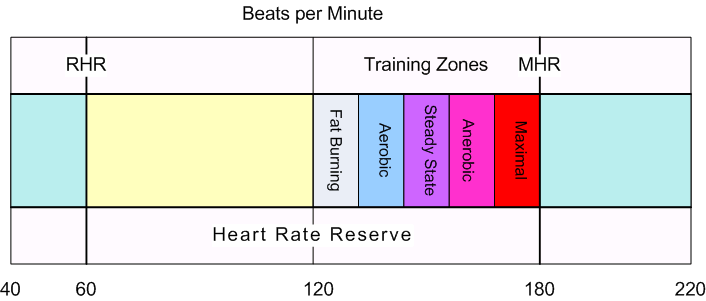
Where and how often we place ourselves in this heart rate reserve will determine our fitness improvements. You obtain different benefits as you progress through the different subzones in your heart rate reserve. Before we talk about each of these subzones it is important to understand that they are approximations. One zone doesn't finish immediately a certain heart rate is reached. The zones tend to meld into one another.

Real benefits from exercise tend to kick in as you move out of the bottom 50% of your heart rate reserve in into your training zones illustrated in the diagram above.

Fat Burning (50 to 60%)

In this range you are developing your basic endurance and aerobic capacity. This zone is great for burning fat compared to the effort you put in. Other zones will also burn up your fat but you will have to work harder to burn up the same amount.

Aerobic (60 to 70%)

This zone is great for your cardiovascular system. This helps your muscles become stronger and more efficient and you develop your bodies ability to transport oxygen to (and carbon dioxide away from) your muscles. You should be spending the majority of your training time in this zone.

Steady State (70 to 80%)

Anaerobic (80 to 90%)

Entering this zone is a sign that you have become serious about your sport. In this zone your body develops its ability to handle lactic acid. An anaerobic workout takes place when you are working so hard that your body cannot keep up with the production of fuel and oxygen and so you need to dip into your reserves. When you dip into your reserves you produce numerous waste products - principally lactic acid.

Maximal (over 90%)

Your Heart Rate Reserves and Training Zones

Calculate your Heart Rate Reserve and Training Zones
Resting Heart Rate: Resting Heart Rate(RHR):   Calculate MHR
Maximum Heart Rate: Maximum Heart Rate(MHR):  
Heart Rate Reserve(HRR):  
Fat Burning: From    to    beats per minute
Aerobic: From    to    beats per minute
Steady State: From    to    beats per minute
Anaerobic: From    to    beats per minute
Maximal: From    to    beats per minute

Step by Step Guide for Calculating Your Training Zones

  • What is your Resting Heart Rate (RHR)

  • What is your Maximum Heart Rate (MHR)

  • Heart Rate Reserve (HRR) equals MHR-RHR

  • Fat Burning Range(bottom)=RHR+hrr*.5

Example

RHR 60
MHR 180
HRR=180-60=120
Fat Burning Range(bottom)=60+(120*50%)=120 bps


Speed

Calculate your speed of travel from your race times and work our the corresponding times for other track distances

Training Zones

The rate at which your heart beats whilst you are exercising has a dramatic effect on the quality of your training and on the rate at which you can loose weight.  Use this calculator to choose your training zone

Business

A Myriad of calculations for effective and efficient management of your business and for achieving what you set out to achieve

Unit Conversions

Convert between many different units for just about anything you can measure

Health

Calculations for managing your physical and mental health through food, cooking, fitness and meditation

Temperature

Convert between various units for temperature.  View a multi-unit scale which shows the ranges for oven temperatures

Science

Calculations that bring science and technology closer to your everyday life

Sport

Calculations for fitness, coaching, performance measurement in a great variety of sports

Weight

Convert between various SI (Metric) and Imperial (UK) units for weight

Pressure

Convert between various SI (Metric) and Imperial (UK) units for pressure

Fuel Consumption

Provide either a measure of fuel consumption or a volume consumed and a distance travelled and calculate the fuel consumption.  Inputs provided and outputs returned in a variety of SI (metric) and imperial (UK) and mixed units

Time

Enter a number of years, days, weeks, hours minutes and seconds and this converter will express the length of time in a myriad of different ways.  For example you can use this converter to calculate the number of seconds in a year.