
|
Enquiries: contactATarmidaleDOTinfo
Temperature Conversions Quick Convertor
There are three temperature scales in common usage today. The SI (metric) system uses the kelvin (K) as it's standard measure with degrees Celcius (oC) as a measure derived from the kelvin (it's sort of the other way around but that's a different story). Last and definitely least is the old measure of degrees Fahrenheit (oF).
As at the beginning of 2005 the SI system had been adopted to some extent in virtually every country except the United States, Liberia and Myanmar (hint, hint) and the fahrenheit temperature scale is only used routinely in the US and Jamaica - it makes a good trivia question - What is it that the United States has in common with Jamaica and nowhere else in the world?.
Kelvins are used almost exclusively in the scientific world. It is the same as the Celsius system except that it can never be negative. This is because it is zero when there is absolutely no heat (called Absolute Zero - the temperature at which every molecule is absolutely still in relation to each other). It is -273.15o Celsius at absolute zero, so to convert from Celsius to Kelvin you add 273.15.
Celsius was creating by Mr Celsius after choosing zero to be the freezing point of pure water and the boiling point at sea level to be 100.
Mr Fahrenheit on the other hand chose zero to be the temperature of the coldest material he could reproduce in his 18th century laboratory. This was ice melting in water saturated with common salt. He then chose 96 (because it is the third doubling of 12, i.e. 12*2*2*2) as the temperature of his wife's armpit. Who else's armpit is that famous?
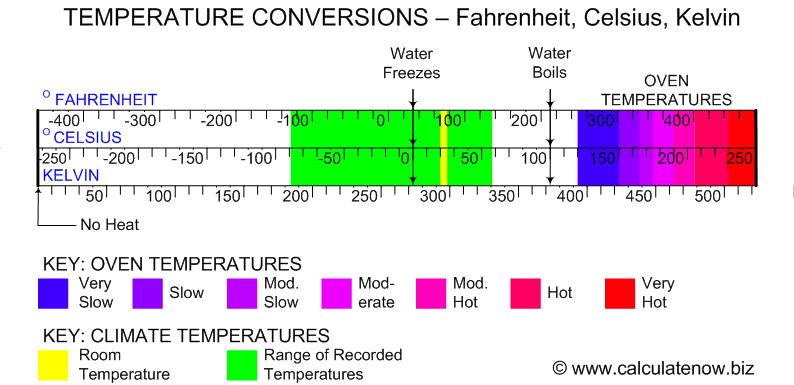
The scale below shows the correspondence between these three scales from Absolute Zero to 250o Celsius and shows some temperature ranges we may be familiar with in everyday life. Below is a calculator to perform conversions from one scale to the others.
Temperature Scale Convertor
This temperature conversion calculator is particularly useful for some of our other calculators, such as the Gas calculator.